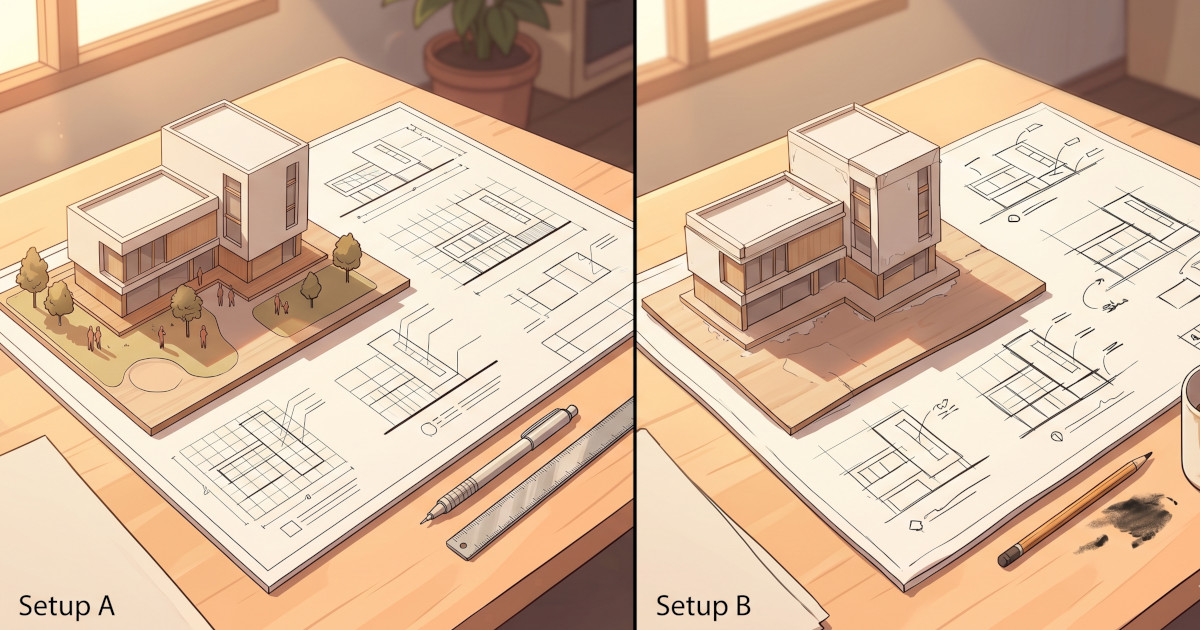
You have two people doing the same recurring job. Both have done it before. Both do decent work. But when you check, the results are different. Not wrong, different. You can see immediately which version is closer to what you wanted. Neither of them would know which one that was.
You have probably chalked it up to experience, or attention to detail, or just how people are. You correct the gap when you spot it. You move on.
Let's think about it
The issue is not one person being better than the other. They are both doing their best version of your standard. The problem is that your standard never left your head intact. When you described the job, each person heard it, interpreted it through their own experience, and built their own working model of what you meant. Those models are similar. They are not the same.
And because the standard was never written down, there is no way for either of them to know which version is closer to yours. They can only go by what you told them, and what they figured out from the feedback they have received since.
Every time you brief verbally, you are not transferring a standard. You are giving each person the raw material to construct their own.
What the research says
There is consistent evidence that verbal instructions produce variable outputs even when everyone involved is trying to follow them. Studies on inter-rater reliability, how consistently two different people apply the same criteria when evaluating the same thing, show that without a written reference, agreement rates between experienced practitioners are often surprisingly low. Not because of carelessness. Because each person is working from their own internal model of what the standard means.
The same pattern shows up in manufacturing quality research. Process variation between workers doing identical tasks drops significantly when written criteria replace verbal instruction. The workers do not become more skilled. The standard becomes less dependent on each worker's interpretation of what skill looks like.
The reconstruction problem
When you tell someone how to do a job, they listen, and then they reconstruct. They fill in the gaps with their own experience. The parts they heard clearly, they apply directly. The parts that were vague, they approximate. The parts you forgot to mention, they guess at.
That reconstruction is invisible to you. You do not see their internal model. You see their output. By then, the variation is already in the work.
And because each person's model drifts slightly over time, shaped by the jobs they do and the feedback they receive, two people who started with the same briefing will diverge further the longer they go without a shared written reference to return to.
What it looks like documented
Let's say you run a commercial cleaning company. You have a standard end-of-tenancy clean. Right now, the quality depends on which team member is on the job and how closely their mental model of "end-of-tenancy clean" matches yours.
You document it:
Activity: Kitchen
- Criteria: Inside all cupboards wiped including shelves and door edges; oven interior cleaned including door glass and seal; extractor filter removed and degreased, not just wiped; all surfaces clear of product residue after cleaning
- Duration estimate: 50 minutes
Activity: Bathroom
- Criteria: Grout scrubbed, not just tile faces; toilet descaled under rim and at base; shower screen cleaned edge-to-edge including track and seal; extractor vent wiped; no product smear on any surface before leaving room
- Duration estimate: 35 minutes
Activity: Final walkthrough
- Criteria: Each room checked from the doorway before moving on; windows checked for smears in natural light; any damage or pre-existing marks noted in the job record; nothing left plugged in or switched on
- Duration estimate: 10 minutes
Now both team members are working from the same model, not two different reconstructions of your verbal briefing. When the work varies, you can see exactly where, because the criteria are specific enough to check against. And when you update the standard, you update it once, and everyone is working from the new version on the next job.
What changes when you review the work
Without written criteria, a review is a conversation about impression. "The kitchen looked good." "Did you get the inside of the cupboards?" "I think so." Nothing is anchored to anything specific.
With criteria, the review is a check against a stated standard. Either the extractor filter was removed and degreased or it was not. Either the grout was scrubbed or the tiles were wiped. The conversation is different, and so is the outcome. You are not correcting someone's interpretation of a vague brief. You are both looking at the same list of things that were agreed, in advance, to be what done well means.
A few approaches, and their tradeoffs
There are a few ways people try to close the consistency gap. Each one has tradeoffs worth being honest about.
Correct variation after the fact. You catch it on the review, give feedback, and expect next time to be better. This works, slowly. But you are correcting a different internal model each time, for each person, and the feedback relies on them remembering it and applying it correctly on the next job. The standard is still in the conversation, not in the work.
More thorough briefing. You spend longer on the handoff, walk through the details, make sure everyone is aligned before they go out. Better than nothing. But a more detailed verbal briefing still produces a more detailed reconstruction, not a shared reference. The next person to join your team will need the same briefing, from scratch. And any update to the standard has to reach every person individually.
Criteria documented at the activity level. The standard is in the job, not in the briefing. Everyone works from the same reference. When the standard changes, it changes once. When a new person joins, they have the same criteria on their first job that your most experienced person uses. Variation does not disappear, but it is now visible against a common baseline, which is the only way to close it systematically.
One way to implement this
The standard has to live somewhere that every person on the job can see, not just the person who briefed them. One approach is WayCharts, built around task templates where each activity carries its own completion criteria. Every team member works from the same reference. The variation that used to live silently in the gap between briefings becomes visible, job by job, against a standard you set once. If that sounds relevant to the way your team works, there is a free trial available. But the principle applies regardless of tooling. A briefing produces interpretations. Criteria produce consistency.
If building a standard your whole team works from sounds worth exploring, WayCharts offers a free 30-day trial. No card required.